

Introduction
Confined space entry operations are common in the oil and gas, construction, marine, manufacturing and industrial sectors. Workers frequently enter tanks, pipelines, vessels, silos, manholes and other enclosed spaces to carry out inspection, cleaning, maintenance and repair activities. However, these operations can expose workers to life-threatening hazards if appropriate safety precautions are not implemented.
This blog explains the essential steps for conducting confined space entry operations safely, preventing accidents and promoting a strong workplace safety culture.
1. Identify and Understand Confined Space Hazards
The first step in conducting a safe confined space entry operation is identifying the hazards associated with the space and the intended work activity.
The hazards can be classified into atmospheric, physical and environmental categories.
Atmospheric hazards include oxygen deficiency, oxygen enrichment, toxic gases such as hydrogen sulphide and carbon monoxide, and flammable gases or vapours.
Physical hazards include moving machinery, electrical equipment, hazardous energy, engulfment by liquids or bulk materials, slippery surfaces and restricted access.
Environmental hazards include extreme temperatures, poor lighting, noise and limited escape routes.
Workers must also consider hazards introduced by the work itself, such as welding fumes, solvent vapours and chemicals used during cleaning.
Identifying these hazards before entry helps determine the necessary control measures and emergency arrangements.
2. Conduct a Confined Space Risk Assessment
A comprehensive risk assessment must be completed before workers enter a confined space. The assessment should identify hazards, evaluate the associated risks and establish appropriate controls.
The assessment should consider the previous contents of the space, the nature of the work, atmospheric conditions, connected pipelines, energy sources, equipment to be used and the number of workers involved.
3. Obtain a Confined Space Entry Permit
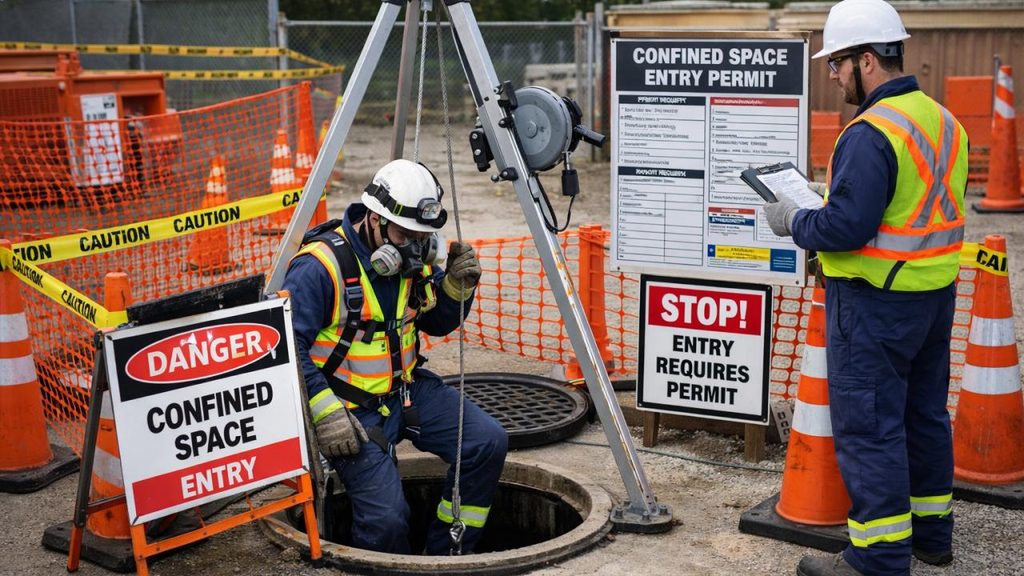
A confined space entry permit is a formal authorisation that confirms the required safety precautions have been established before entry.
Where required by applicable regulations or the site’s permit-to-work system, the permit must be approved before work begins.
The permit should identify the confined space, work location, task description, authorised entrants, entry supervisor, standby attendant and required control measures.
It should also specify isolation arrangements, atmospheric testing requirements, ventilation, PPE, communication methods and emergency rescue procedures.
Before authorising entry, the responsible supervisor must verify that the required precautions are in place and that the personnel involved understand their responsibilities.
4. Isolate Hazardous Energy Sources
Energy isolation is essential to prevent unexpected equipment operation or the release of hazardous substances into the confined space.
Depending on the task, isolation may involve electrical lockout/tagout (LOTO), mechanical isolation, closing and securing valves, disconnecting pipelines, draining liquids and depressurising equipment.
Blinding or physically disconnecting pipelines may be necessary where valve isolation alone cannot provide adequate protection.
Isolation must be carried out by authorised personnel in accordance with an approved procedure. The effectiveness of the isolation should be verified before entry.
Proper isolation reduces the risk of unexpected releases, equipment movement, fire, chemical exposure and other serious incidents.
5. Test the Atmosphere Before Entry
Atmospheric testing is one of the most important steps in confined space safety. A confined space may contain dangerous gases even when it appears clean and has no noticeable odour.
A competent gas tester should use a suitable, calibrated and function-checked gas detector to test for hazards identified in the risk assessment.
Testing commonly includes oxygen concentration, flammable gases and vapours, and relevant toxic gases such as hydrogen sulphide and carbon monoxide.
If readings are outside the approved limits, entry must not be authorised until the hazards have been controlled and the atmosphere reassessed.
6. Provide Adequate Ventilation
Ventilation helps remove contaminants and maintain acceptable atmospheric conditions inside a confined space.
Depending on the hazards, mechanical ventilation may be required to introduce fresh air or extract contaminated air. Ventilation equipment must be suitable for the environment and must not introduce additional hazards.
Ventilation should continue throughout the operation when required by the risk assessment. Atmospheric monitoring must also continue at the specified frequency.
7. Use Appropriate Personal Protective Equipment
Personal protective equipment (PPE) must be selected according to the hazards identified during the risk assessment.
Depending on the task, PPE may include safety helmets, protective coveralls, safety boots, chemical-resistant gloves, eye protection, hearing protection and suitable respiratory protection.
A full-body harness and retrieval equipment may also be necessary where a suitable rescue and retrieval system can be used safely.
Respiratory protection must be appropriate for the atmosphere and the exposure risk. Air-purifying respirators do not supply oxygen and must never be used in oxygen-deficient atmospheres.
8. Appoint a Trained Standby Attendant
A trained standby attendant must remain outside the confined space whenever required by the entry procedure.
The attendant is responsible for monitoring the entrants, maintaining communication, keeping an accurate record of personnel inside the space and watching for changing conditions.
The attendant must also initiate evacuation when necessary, summon emergency assistance and prevent unauthorised persons from entering.
The attendant should not perform duties that interfere with these responsibilities.
Importantly, the attendant must not attempt an improvised rescue by entering the confined space. Unplanned entry can expose the rescuer to the same hazards and lead to multiple fatalities.
9. Establish an Emergency Rescue Plan
A practical emergency rescue plan must be prepared before entry begins. The plan should address foreseeable emergencies, including atmospheric exposure, collapse, injury, engulfment and loss of communication.
It should identify trained rescue personnel, suitable rescue equipment, communication arrangements, retrieval methods and first-aid resources.
Rescue arrangements should be practised periodically, and equipment must be inspected and maintained. Organisations must ensure that rescue resources are available and capable of responding within a suitable timeframe.
10. Monitor the Operation and Close Out the Permit
Before entry begins, the supervisor should conduct a pre-entry safety briefing covering the hazards, permit conditions, isolation arrangements, atmospheric test results, communication methods and emergency procedures.
During the operation, workers must follow the approved work method and maintain atmospheric monitoring at the frequency specified by the risk assessment.
After the work is completed, the supervisor must confirm that all personnel have exited and been accounted for. Tools and equipment should be removed where appropriate, the area secured and the permit formally closed.
Conclusion
Conducting a safe confined space entry operation requires careful planning, comprehensive risk assessment, effective energy isolation, atmospheric testing, ventilation, suitable PPE, competent supervision and emergency rescue preparedness.
Employers must ensure that workers understand the hazards and receive appropriate training before undertaking confined space entry duties.
For confined space entry and rescue training, contact Primelift Safety Resources Limited (PSRL).
Website: www.primeliftsafetyng.com
Email: training@primeliftsafetyng.com
Phone: +234 911 568 7051