

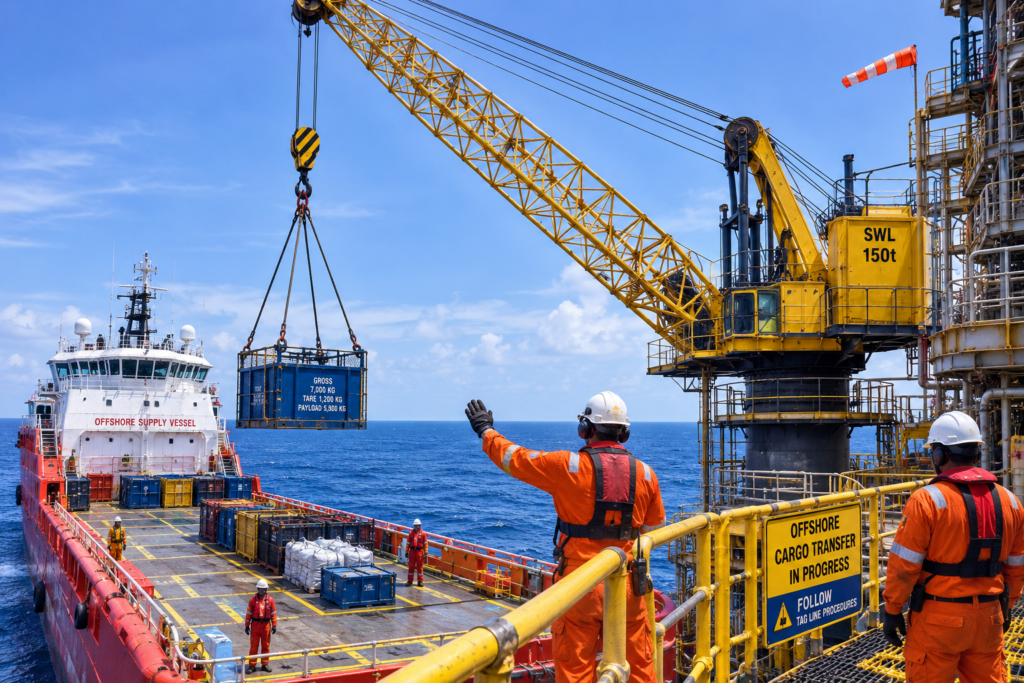
Offshore crane operations are essential for moving equipment, materials, containers, and personnel between offshore installations and supply vessels. However, offshore crane operations involve significant hazards that can result in dropped objects, equipment damage, serious injuries, or fatalities if they are not properly controlled.
Effective hazard control requires proper planning, competent personnel, suitable equipment, and strict compliance with safe lifting procedures.
Hazards Associated with Offshore Crane Operations
- Dropped Loads: Failure of lifting equipment, poor rigging, or incorrect lifting techniques can cause suspended loads to fall, resulting in fatalities, injuries, and equipment damage.
- Adverse Weather Conditions: High winds, heavy rain, lightning, poor visibility, and rough sea states can reduce offshore crane stability and make load control difficult.
- Dynamic Vessel Motion: Rolling, pitching, and heaving of vessels increase the risk of uncontrolled load movement during offshore lifts.
- Crane Overloading: Exceeding the offshore crane’s Safe Working Load (SWL) can lead to structural failure or crane overturning.
- Swinging and Uncontrolled Loads: Wind and vessel movement can cause loads to swing, creating struck-by and collision hazards.
- Personnel in the Line of Fire: Workers positioned beneath or close to suspended loads are at risk of serious injury or death.
- Equipment Failure: Mechanical, hydraulic, electrical, or wire rope failures can result in loss of load control.
- Poor Communication: Ineffective communication between the offshore crane operator, banksman, and rigging team can lead to unsafe lifting operations.
- Collision Hazards: Crane booms or suspended loads may collide with vessels, offshore structures, pipelines, or other equipment.
- Environmental Hazards: Oil spills, hazardous materials, and fire or explosion risks may increase the consequences of lifting incidents.
Hazards Control in Offshore Crane Operations
1. Conduct a Thorough Lifting Risk Assessment
Before every lifting operation, identify potential hazards such as suspended loads, crane overload, poor visibility, vessel movement, adverse weather, and dropped objects. A suitable lifting risk assessment should define control measures and ensure that everyone involved understands their responsibilities.
2. Use Competent and Trained Personnel
Only trained and competent offshore crane operators, riggers, banksmen, slingers, and lifting supervisors should participate in offshore lifting operations. Competency should be regularly assessed and maintained through appropriate offshore crane operator training and refresher training.
3. Inspect the Crane and Lifting Accessories
Before use, inspect the crane, wire ropes, hooks, shackles, slings, spreader beams, lifting baskets, and other accessories. Safety-critical devices such as the Load Moment Indicator (LMI), anti-two-block system, emergency stop, limit switches, and overload protection should be functional.
Defective equipment must be removed from service immediately.
4. Control Suspended Load Hazards
Personnel should never stand or work beneath suspended loads. Establish and enforce an exclusion zone around the lifting area. Loads should be properly rigged, balanced, and secured to prevent shifting or falling during lifting.
5. Consider Weather and Environmental Conditions
Wind, waves, vessel motion, poor visibility, rain, and sea conditions can significantly affect offshore lifting operations. Offshore crane operations should be suspended when environmental conditions exceed the limits specified by the crane manufacturer, lifting plan, or company procedures.
6. Maintain Effective Communication
Clear communication between the crane operator, banksman, rigger, lifting supervisor, and vessel crew is essential. Standard hand signals, radios, and agreed communication protocols should be used. Everyone involved should understand the stop-work signal and have the authority to stop an unsafe operation.
7. Follow an Approved Lifting Plan
Complex and critical offshore lifts should be properly planned and supervised. The lifting plan should consider load weight, crane capacity, radius, lifting points, sea state, vessel movement, rigging configuration, landing area, and emergency arrangements.
8. Prevent Dropped Objects
Dropped objects are among the major hazards associated with offshore crane operations. Tools, loose equipment, rigging components, and materials should be secured against falling. Regular inspection of lifting areas and dropped-object prevention measures can significantly reduce risk.
9. Establish Emergency Procedures
Emergency arrangements should cover crane failure, loss of power, uncontrolled load movement, adverse weather, communication failure, personnel injury, and other foreseeable emergencies. Drills and toolbox talks should ensure that workers understand how to respond.
Importance of Regular Offshore Crane Operations Training
Regular training plays a major role in controlling hazards in offshore crane operations. Training should be appropriate to the responsibilities of each member of the lifting team.
Offshore crane operators should understand safe crane operation, load charts, crane limitations, safety devices, environmental factors, and emergency procedures. Riggers and slingers should understand load characteristics, lifting accessories, rigging configurations, inspection requirements, and safe lifting practices. Banksmen should understand signaling, communication, load movement, exclusion zones, and coordination with crane operators.
Organizations should also provide training in lifting operations planning, lifting risk assessment, dropped-object prevention, and other relevant areas.
To ensure competence of personnel and safety in your lifting operations, contact us for our offshore crane operation trainings through our website: www.primeliftsafetyng.com or call +234 9115687051. Email us at training@primeliftsafetyng.com