

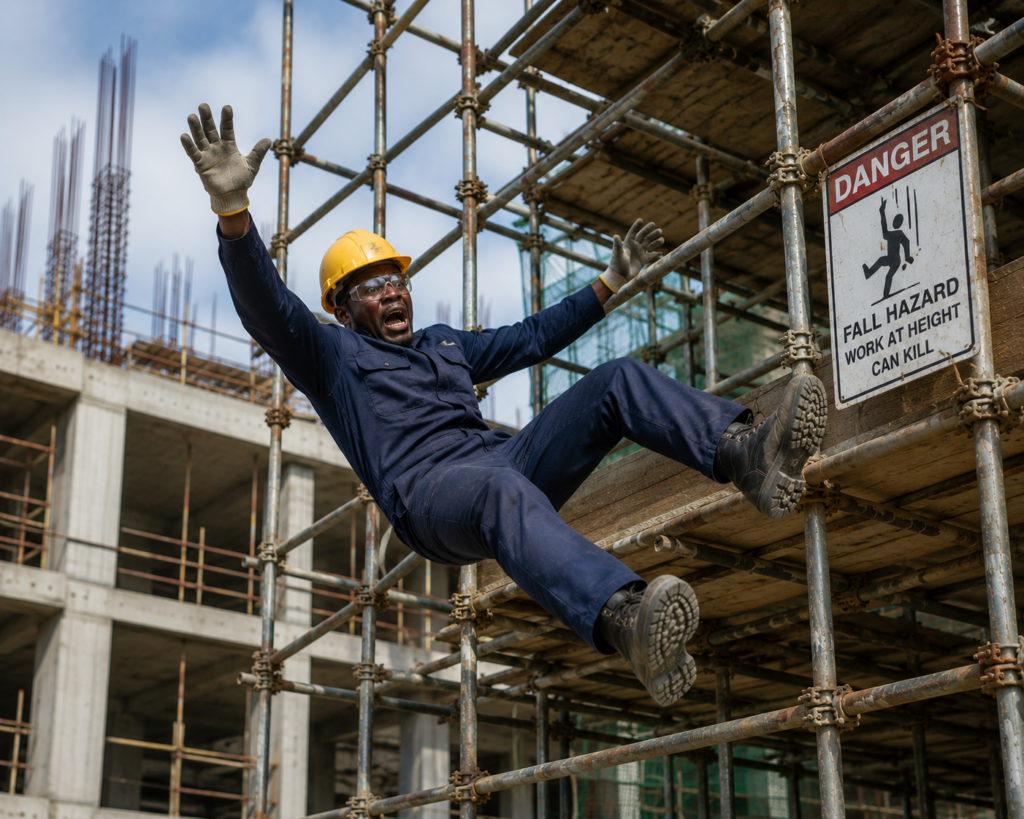
Falls from height remain one of the leading causes of serious injuries and fatalities in the construction industry worldwide. Every year, thousands of construction workers suffer life-changing injuries due to falls from scaffolds, ladders, roofs, elevated work platforms, structural steel, and other elevated work areas.
Preventing falls from height in construction is not simply about complying with legal requirements; it is about protecting lives, improving productivity, reducing project delays, lowering insurance costs, and building a strong safety culture. Every employer, contractor, supervisor, and worker has a shared responsibility to ensure that work at height is properly planned, supervised, and executed using appropriate fall protection systems.
Understanding Falls from Height
A fall from height in construction occurs whenever a person falls from one level to another where the distance could cause injury. Contrary to popular belief, even a fall from less than two meters can result in permanent disability or death depending on the circumstances.
Construction activities that commonly involve working at height include roof installation, steel erection, scaffolding, painting, cladding installation, electrical works, concrete formwork, tower crane maintenance, telecommunications installation, bridge construction, and maintenance operations.
Because these activities expose workers to significant risks, employers must implement comprehensive fall prevention strategies before work begins.
Why Falls Continue to Occur on Construction Sites
Many construction accidents are entirely preventable. Unfortunately, organizations often underestimate the hazards associated with working at height until a serious incident occurs.
Falls from height in construction frequently happen because workers are not adequately trained to recognize hazards or use fall protection equipment correctly. Unsafe scaffolding, damaged ladders, missing guardrails, slippery surfaces, poor housekeeping, adverse weather conditions, inadequate supervision, and rushing to meet project deadlines all contribute significantly to fall-related accidents.
Human factors such as fatigue, complacency, distraction, and poor communication further increase the likelihood of falls.
Conduct a Thorough Work at Height Risk Assessment
The foundation of every successful fall prevention program begins with a comprehensive risk assessment.
Before any work starts, employers should identify every activity that involves working at height, evaluate the associated hazards, determine who may be exposed, assess the level of risk, and implement suitable control measures.
A risk assessment should also consider environmental factors such as strong winds, rain, unstable ground conditions, overhead power lines, falling objects, confined working spaces, and simultaneous operations that may increase hazards.
Risk assessments should never be treated as paperwork exercises. They must be reviewed continuously as work progresses and updated whenever site conditions change.
Plan the Work Before Anyone Leaves the Ground
One of the most effective ways to prevent falls is proper planning.
Construction managers should ask whether the work can be completed without working at height. If the task can safely be performed from ground level using extendable tools, drones for inspections, prefabrication techniques, or alternative methods, then working at height should be avoided altogether.
Proper planning ensures that the right equipment, competent personnel, rescue procedures, supervision, and emergency arrangements are in place before work begins.
Good planning significantly reduces the likelihood of unexpected hazards developing during construction activities.
Select the Appropriate Fall Protection System
Choosing the correct fall protection equipment is essential for worker safety.
Collective protection systems such as guardrails, edge protection, safety nets, and temporary barriers should always be considered before relying on personal protective equipment.
Where collective protection cannot eliminate the risk, personal fall protection systems including full-body harnesses, shock-absorbing lanyards, self-retracting lifelines, inertia reels and horizontal lifeline systems should be used.
Every component of the fall arrest system must be compatible, inspected before use, and installed by competent persons.
Using poor-quality or defective fall protection equipment significantly increases the risk of equipment failure during a fall.
Ensure Scaffolds Are Properly Designed and Inspected
Scaffolding remains one of the safest working platforms when erected correctly.
Every scaffold should be designed according to applicable standards, erected by competent scaffold erectors, inspected before first use, and re-inspected after adverse weather conditions or structural modifications.
Workers should never remove guardrails, alter scaffold components, overload working platforms, or climb scaffold frames instead of using designated access ladders.
Regular scaffold inspections help identify loose boards, damaged components, missing braces, unstable foundations, and other defects before they lead to accidents.
Use Ladders Safely
Although ladders are common on construction sites, they are frequently involved in fall accidents.
Ladders should only be used for short-duration, low-risk tasks where safer alternatives are not reasonably practicable.
Before use, workers should inspect ladders for cracks, bent rails, damaged feet, missing rungs, or other defects. The ladder should be positioned on firm, level ground and secured to prevent movement.
Maintaining three points of contact while climbing significantly reduces the likelihood of slipping or losing balance.
Workers should avoid carrying heavy tools while climbing and should never stand on the top rung unless the ladder is specifically designed for that purpose.
Provide Comprehensive Work at Height Training
Training is one of the most effective investments any construction company can make.
Workers should understand how falls occur, recognize hazards, conduct equipment inspections, wear harnesses correctly, calculate fall clearance distances, use anchor points safely, and respond effectively during emergencies.
Supervisors should also receive advanced training in risk assessment, permit-to-work systems, rescue planning, inspection requirements, and legal responsibilities.
Continuous refresher training ensures workers remain competent as regulations, equipment, and construction methods evolve.
Organizations with properly trained employees experience fewer accidents, improved productivity, higher morale, and greater compliance with occupational safety legislation.
Inspect Fall Protection Equipment Regularly
Even the highest-quality equipment can become unsafe if it is poorly maintained.
Harnesses, lanyards, connectors, carabiners, lifelines, anchor devices, and self-retracting lifelines should be inspected before every use and subjected to periodic detailed inspections by competent persons.
Equipment that shows signs of cuts, burns, chemical damage, corrosion, excessive wear, deformation, or missing labels should be removed from service immediately.
Maintaining proper inspection records demonstrates compliance and helps ensure defective equipment is not accidentally reused.
Maintain Good Housekeeping
Poor housekeeping contributes significantly to slips, trips, and falls.
Construction sites should be kept clean, organized, and free from unnecessary debris, loose materials, protruding objects, trailing cables, and accumulated waste.
Walkways should remain unobstructed, and materials should be stored securely to prevent creating trip hazards.
Good housekeeping not only prevents falls but also improves efficiency and project organization.
Monitor Weather Conditions
Weather conditions can rapidly increase fall risks.
Heavy rain, high winds, lightning, fog, and extreme temperatures reduce visibility, affect worker concentration, and make working surfaces slippery.
Construction managers should continuously monitor weather forecasts and suspend work at height whenever environmental conditions become unsafe.
Resuming work should only occur after a competent person confirms that conditions are once again suitable.
Establish an Effective Rescue Plan
Having fall protection equipment alone is insufficient.
Every organization should have a documented rescue plan that explains how suspended workers will be rescued promptly following a fall.
Prolonged suspension in a harness can lead to suspension trauma, a potentially fatal medical condition if rescue is delayed.
Emergency procedures should include rescue equipment, trained rescue personnel, communication methods, emergency contact numbers, first aid arrangements, and regular rescue drills.
A well-practiced rescue plan can mean the difference between life and death.
Build a Strong Safety Culture
The safest construction sites are those where safety is embedded into daily operations rather than treated as a regulatory obligation.
Management should demonstrate visible leadership by investing in safety training, encouraging hazard reporting, conducting regular toolbox talks, rewarding safe behaviors, and empowering workers to stop unsafe work without fear of retaliation.
When employees believe that safety is valued above production targets, compliance improves naturally and accident rates decline significantly.
If you are looking for professional Work at Height and Rescue Training, contact Primelift Safety Resources Limited today. Call us on +234 9115687051. Email: training@primeliftsafetyng.com. www.primeliftsafetyng.com