

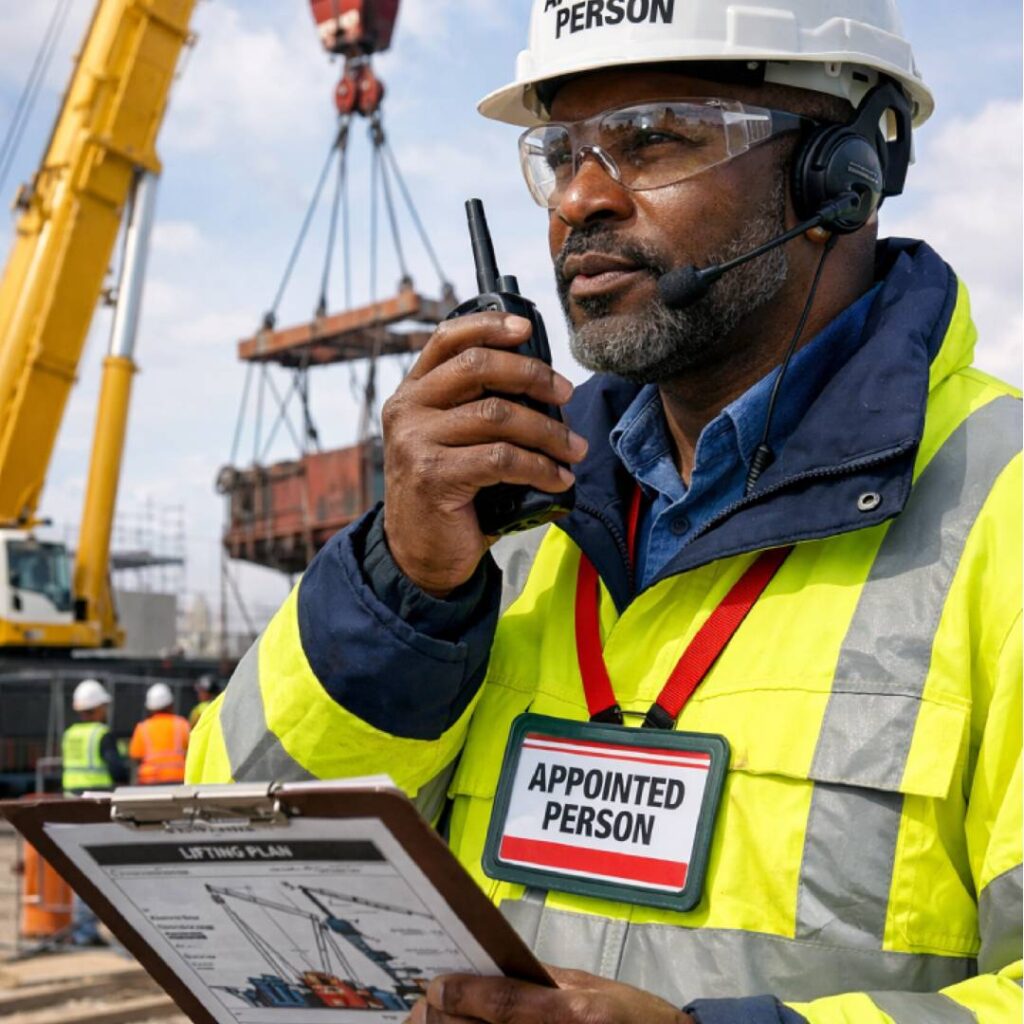
Lifting operations are among the highest-risk activities in construction, oil & gas, manufacturing, ports, and heavy industry. cranes, hoists, forklifts, and other lifting equipment handle massive loads, often over people, structures, and critical assets. One mistake can lead to serious injury, fatalities, or costly damage.
This is why regulations and best practice standards require the appointment of a competent Appointed Person (AP) to plan, manage, and control lifting operations.
The Appointed Person is the individual with overall responsibility for ensuring that lifting operations are properly planned, risk assessed, supervised, and carried out safely.
In this blog, we’ll break down the key duties of an Appointed Person and why the role is so critical.
1. Overall Responsibility for Lifting Operations
The Appointed Person has overall control of the lifting operation from planning to execution. This includes:
- Ensuring every lift is properly planned
- Making sure the right equipment is selected
- Confirming that competent people are assigned to each role
- Ensuring the lift is carried out in a safe and controlled manner
In short, the AP is accountable for the safety, coordination, and technical correctness of the lifting operation.
2. Planning the Lifting Operations
One of the most important duties of the Appointed Person is lift planning.
This includes:
- Assessing the load (weight, shape, center of gravity)
- Choosing the correct type and capacity of crane or lifting equipment
- Selecting suitable lifting accessories (slings, shackles, spreader beams, etc.)
- Deciding the lifting method (single crane lift, tandem lift, tailing lift, etc.)
- Defining the lifting path and final landing position
- Identifying hazards such as overhead power lines, underground services, weak ground, nearby structures, and people
For routine lifts, this may be done using standard lift plans. For complex or high-risk lifts, the AP must prepare a detailed, written lift plan and method statement.
3. Conducting Risk Assessment
The Appointed Person must ensure that a proper risk assessment is carried out before any lifting operation.
This involves:
- Identifying hazards associated with the lift
- Evaluating the risks to workers, equipment, and the environment
- Defining control measures to eliminate or reduce risks
- Ensuring emergency procedures are in place
Typical hazards include:
- Crane overturning or overloading
- Falling loads
- Collision with structures or people
- Failure of lifting accessories
- Poor ground conditions
- Weather effects (wind, rain, poor visibility)
The AP ensures that these risks are controlled to as low as reasonably practicable (ALARP).
4. Selecting Suitable Lifting Equipment for the Lifting Operations
Another critical duty is equipment selection.
The Appointed Person must ensure that:
- The crane or lifting equipment has sufficient capacity for the load and radius
- The equipment is suitable for the environment and task
- The lifting accessories are appropriate for the load and lifting method
- All equipment is properly certified, inspected, and in good condition
This includes checking:
- Crane load charts
- Sling and shackle capacities
- Certification and inspection records
- Any special attachments or lifting points
Using the wrong equipment is one of the biggest causes of lifting accidents—and the AP is responsible for preventing that.
5. Appointing Competent Lifting Team Members
A lifting operation is a team effort. The Appointed Person must ensure that only competent and trained personnel are used, such as:
- Crane Operator
- Lifting Supervisor
- Rigger / Slinger
- Banksman / Signaller
The AP must:
- Define each person’s role and responsibility
- Confirm they are trained, competent, and authorized
- Ensure clear lines of communication and command on site
Everyone must know who is in charge of the lift and who gives instructions to the crane operator.
6. Producing the Lift Plan and Method Statement
For non-routine, heavy, or complex lifts, the Appointed Person must prepare a written lift plan. This document typically includes:
- Description of the load
- Weight and dimensions of the load
- Lifting equipment to be used
- Rigging arrangement and lifting points
- Crane position and working radius
- Step-by-step lifting procedure
- Risk assessment and control measures
- Emergency and contingency plans
- Names and roles of lifting team members
The lift plan serves as the technical and safety roadmap for the entire operation.
7. Ensuring Proper Supervision during the Lifting Operations
The Appointed Person must ensure that lifting operations are properly supervised—usually by a Lifting Supervisor.
Their duty includes:
- Making sure the lift is carried out according to the approved plan
- Ensuring site conditions have not changed (ground, weather, access, etc.)
- Confirming exclusion zones are in place and respected
- Stopping the lift if unsafe conditions arise
Even the best plan is useless if it is not followed on site. Supervision is key.
8. Managing Changes and Non-Routine Situations
In real life, things change. The Appointed Person must ensure that:
- Any significant change in the lift (load, equipment, method, environment) is reviewed
- The lift plan and risk assessment are updated if necessary
- Work is stopped if conditions become unsafe (e.g., high winds, equipment fault, ground failure)
The AP has the authority—and the responsibility—to pause or cancel a lift if safety is compromised.
9. Ensuring Compliance with Legal and Company Requirements
The Appointed Person must ensure that all lifting operations comply with:
- Relevant laws and regulations (e.g., LOLER, local safety laws, industry standards)
- Company procedures and permit-to-work systems
- Client and project safety requirements
This includes ensuring:
- Equipment inspections and certifications are valid
- Operators and riggers are properly trained and authorized
- Documentation is completed and approved
10. Reviewing and Learning from Lifting Operations
After lifting operations, especially complex or critical lifts, the Appointed Person should:
- Review how the lift went
- Identify any issues, near-misses, or improvements
- Update procedures and plans where necessary
- Share lessons learned with the team
This continuous improvement approach helps prevent future incidents and raises overall lifting safety standards.
Why the Appointed Person Role is so Important in Lifting Operations
The Appointed Person is not just a “paperwork” role. They are the technical authority and safety leader for lifting operations. Their decisions directly affect:
- The safety of workers
- The protection of equipment and structures
- The success or failure of critical lifts
- The legal and financial risk to the company
A competent Appointed Person can be the difference between a smooth, safe lift and a serious accident.
Conclusion
The duties of an Appointed Person for lifting operations cover planning, risk management, equipment selection, team coordination, supervision, and compliance. It is a role that requires strong technical knowledge, practical experience, and a firm commitment to safety.
In any organization that carries out lifting operations, appointing a competent and properly trained Appointed Person is not optional—it is essential for safe, legal, and efficient lifting work.
Primelift Safety Resources Limited provides lifting operations training to ensure the competency of personnel.
Contact us on +2348037957878 or Email us at training@primeliftsafetyng.com.
www.primeliftsafetyng.com.