

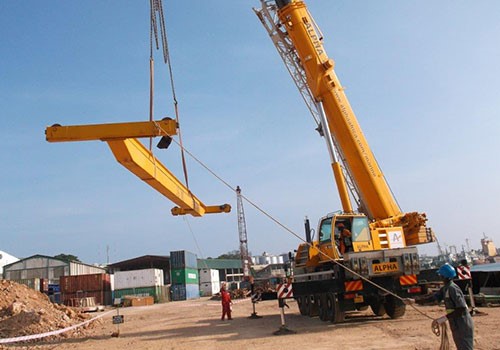
A tagline is generally a length of rope or webbing with or without a connector which is attached to a load during a lifting operation to allow a rigger/operator to control swinging and/or rotation of a suspended load. Multiple taglines may be required to apply and implement full control of a suspended load.
Purpose of a tagline in lifting operations
Taglines should be used to:
• Assist in the control of any swing induced by the lifting of the load.
• Alter the rotational attitude of a suspended load as it is guided along a path or to position the load in a particular orientation.
• Counteract the uncontrolled rotation of a freely suspended load as it is lifted and manoeuvred under the influence of ungovernable forces, such as the wind.
• Help stabilize a load while enabling personnel to maintain a safe distance from the load.

Taglines should not be used to:
• Pull the load out of its natural plumb suspended line.
• Induce recovery or pay out of the load line.
• Contribute to the supporting of the load.
• Lash or drag a load and should not be wrapped or tied around yourself or any fixed point.
Tag lines should NOT be used if they create a safety hazard. Instances such as:
• They would cause the handler to be placed near a pinch point or in a position where they could become crushed.
• There is not a clear travel path for the handler to be able to walk through without trip hazards or without causing potential snagging hazards.
• When the loads rotation is excessive and cannot physically be controlled via taglines.
• When there is not enough clearance for the tag line handler to keep out of the fall zone.
Before making the determination not to use a tag line, be sure and fully risk asses the operation with the lifting team. If a tag line is necessary for positioning or load control, but it is going to create more of a safety hazard then it is important consider other alternatives, such as push/pull poles or some other type of control measure.
Plan your Tagline use
Taglines should be used on all loads that may swing or spin and taglines are recommended on all loads, unless they would serve no purpose and or could create a hazard. How many taglines you would need, where they should be located and what their purpose is, need to be evaluated as part of the lift planning exercise and should come out of the risk assessment.
Tag lines may for instance not be required to stop rotation but may be required to receive, steady and finally position the load, keeping people at a distance.
Things to consider when using a Tagline during lifting operations
• A heavy load which is moving has inertia and can take a lot of stopping.
• Wind speed increases with height.
• Possible wind funnelling effects, exposure when clear of structures.
• Size of load, shape of load, weight of load.
• The importance of clearances between the load and the crane, lines, structures etc.
• The ability to locate and or pass over taglines.
• The capability of the tagline operator/rigger to maintain adequate position and control of the load during the lift.
Attaching a Tagline
Taglines should be:
• Attached to the load towards its lateral extremes so as to get the best control against rotation.
• Attached to a lug, structural member or other substantial and solid part of the load capable of taking a significant force without being deformed or damaged.
Taglines should NOT be:
• Attached to the rigging (unless this is the only option and it has been assessed as safe to do so)
• Attached where they could slip off as the operation proceeds or as the load moves.
• Attached to valves, door handles or other pieces of equipment which could move or not be strong enough to withstand the loads applied to them.
Picking a Tagline Length
Firstly, assess the required control parameters:
• Do you require control throughout the entire operation?
• Is control only required during pick up and landing?
• Will control need to be passed between personnel?
• Will the tagline be left unattended at any point during the lift and if so, have the risks of this been assessed in regard to the length of tagline selected?
Taglines need to be:
• Long enough to keep you at a safe distance from the load.
• Long enough to reach and move to the manipulation point without compromising the users’ safety or ability to manipulate the load.
• Not so long as to introduce a snagging hazard.
The line between the handler and the attachment point should always be clear and uninterrupted so that the tagline is not required to pass over, around or under any part of the load as the operation proceeds.
Tagline Safety Tips
• Boat hooks, push / pull poles or similar devices must be used to retrieve taglines hanging down vertically from a load.
• Ensure you have a clear unobstructed path for tagline handlers.
• You should never have a tagline wrapped around any part of your body or around any fixed point.
• Be aware of what is happening around you and above you.
• Users are urged to wear gloves as this helps you avoid the possibility of friction burns and provides better grip of the tagline.
• Be sure if you are guiding a load with a tag line that your travel path is clear and safe before the load is suspended.
• All sections of the tagline, including the slack, should be kept in front of the handler at all times.
• The tagline should be appropriately attached to the load only and not to the lifting and or hoisting accessories.
• Never step into a loop in a tagline.
• Never place yourself between an immovable object and a load that is not firmly and completely landed on the ground.
• Do not position yourself where you could be trapped and if you find yourself becoming endangered you should release the tagline to avoid the hazard.
To ensure competence of personnel and safety in your lifting operations, place a request for our rigging and lifting operations trainings through our website: www.primeliftsafetyng.com, Call +234 9115687051 or Email us at training@primeliftsafetyng.com