

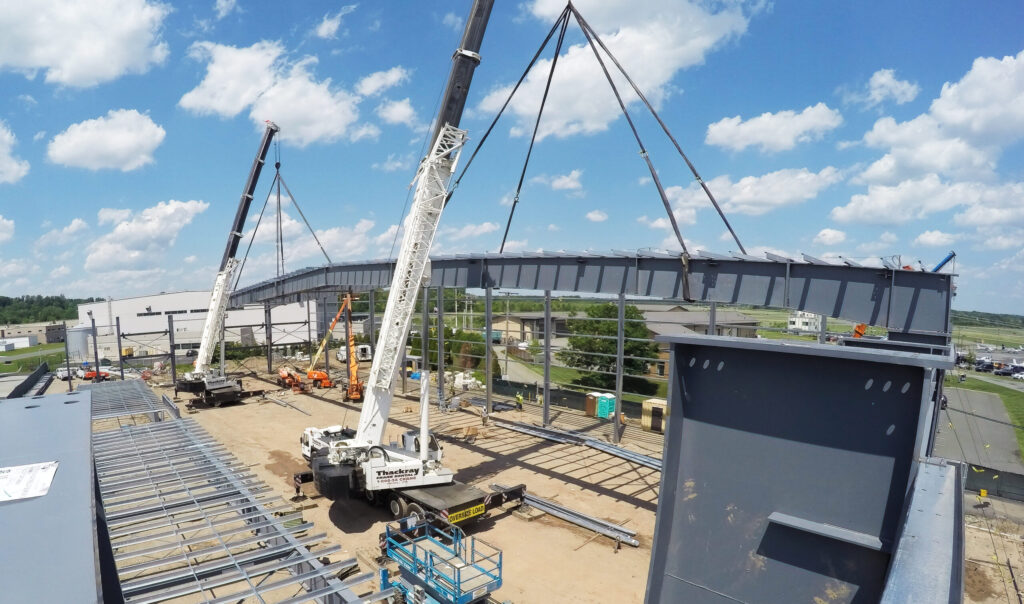
Improper sling angles during lifting operations are a critical but often overlooked safety hazard. These dangers are not always obvious, especially to untrained workers, which makes them particularly insidious. Understanding sling angles is important for preventing serious accidents during lifting operations.
As the angle between the sling leg and the horizontal plane decreases, the stress on that leg increases, sometimes doubling the load-bearing requirement.
Here are the hidden dangers of improper sling angle:
1. Exponential Increase in Sling Tension
- The 60-Degree Rule: A 60-degree angle from the horizontal is considered a safe, standard minimum; at this angle, tension on each leg increases by approximately 15–20%.
- The 45-Degree Danger Zone: When angles drop below 45 degrees, the risk of failure increases sharply. At 45 degrees, tension increases by roughly 40%.
- The 30-Degree Failure Zone: At a 30-degree angle, the tension on each leg nearly doubles, effectively forcing a sling rated for a 10-ton vertical lift to carry 10 tons of force at a much lower capacity.
- Below 30 Degrees: Using angles below 30 degrees is extremely dangerous and generally discouraged, as it can cause the load on a single leg to exceed the total weight of the object.
2. Physical and Structural Damage of Slings
- Sling Distortion & Failure: Wire rope can suffer from crushed strands, while synthetic slings (webbing slings/round slings) can stretch excessively or suffer from friction burns and abrasion, especially at sharp angles.
- Hardware Failure: Low angles introduce severe horizontal forces, which can bend or snap hooks, shackles, and lifting lugs or pad eyes.
- Load Slippage: Shallow angles (less than 45 degrees) reduce the frictional force holding the load, significantly increasing the risk of the load slipping out of a choker hitch.
3. Hidden “Silent” Risks
- “It Looked Okay” Fallacy: Many lifting accidents occur because the sling didn’t break immediately in the past, but the accumulated fatigue damage from repeated low-angle lifts causes sudden, unpredictable failure.
- Underestimated Load Distribution: If the load’s center of gravity is not centered between the pick points, one sling leg may take significantly more weight than the other, overloading it even faster than calculations predict.
- Shock Loading: Low-angle, unstable loads are prone to swinging or jerking, which can instantaneously spike the tension beyond the breaking point.
How to Mitigate the Risks of Improper Sling Angles
- Plan the Lift: Always conduct a lift plan and risk assessment. Calculate the required sling length to achieve an angle of 60 degrees or greater from the horizontal.
- Use Longer Slings: Increase the vertical distance between the hook and the load to improve the sling angle.
- Use Spreader Beams: For long loads, spreader beams can lift the load vertically, eliminating horizontal pressure or crushing forces and ensuring the load is within each sling’s WLL.
- Know the Rated Capacity: Use slings with tags that show rated capacities at different angles (e.g., 60o, 45o, 30o).
- Train Riggers: Ensure all rigging personnel understand the angle-tension relationship and can identify unsafe angles visually.
- Calculate Sling Tension: Never assume a sling can lift its full rated capacity at a low angle. Consult load angle factors (LAF) or, in the case of a 2-leg hitch at 30 degrees, assume the load on each leg is 100% of the weight.
Conclusion
Sling angles don’t just affect slings, they affect the entire lifting operations including the load itself, all rigging hardware, and the crane’s stability.
Understanding safe sling angle in rigging and lifting operations is a fundamental requirement for preventing equipment failure, dropped objects and serious or fatal injuries.
Interested in learning more? We offer lifting operation trainings at Primelift Safety Resources Limited.
Call us on +234 9115687051. Email us at training@primeliftsafetyng.com for more information. www.primeliftsafetyng.com