
What is a Job Hazard Analysis (JHA)?
A job hazard analysis (JHA), also called a job safety analysis (JSA), is a technique used to identify the hazards of specific tasks in order to reduce the risk of injury to workers.
Job hazard analysis (JHA) is an important tool for identifying and reducing hazards in the workplace. Job hazard analysis (JHA) is a simple mean of looking at the work task and considering what is the safest way to complete it. It is a way of becoming aware of the hazards involved in doing the job and taking action to prevent an injury.
What Jobs are Appropriate for a Job Hazard Analysis (JHA)?
A job hazard analysis (JHA) can be conducted on many jobs in your workplace. Priority should go to the following types of jobs:
• Jobs with the highest injury or illness rates;
• Jobs with the potential to cause severe or disabling injuries or illness, even if there is no history of previous accidents;
• Jobs in which one simple human error could lead to a severe accident or injury;
• Jobs that are new to your operation or have undergone changes in processes and procedures; and
• Jobs complex enough to require written instructions.
Importance of Job Hazard Analysis (JHA)
- Improve job planning
- Help employees recognize potential hazards
- Engage all employees in determining the need for safety precautions
- Assure that all employees are following the proper work practices
- Assure good communication between all involved
- Increased productivity
- A tool for incident investigation
- Assists in compliance with regulatory requirements
Steps in Conducting a Job Hazard Analysis (JHA)
Four basic steps in conducting a JHA are:
- Selecting the job to be analysed
- Breaking the job down into a sequence of steps
- Identifying potential hazards
- Determining preventive measures.
- Selecting the job to be analysed
A job hazard analysis (JHA) can be performed for all jobs in the workplace, whether the job task is special (non-routine) or routine. A job hazard analysis should be conducted first for jobs with the highest rates of disabling injuries and illnesses.
Also, jobs where close calls or near misses have occurred should be given priority. Analyses of new jobs and jobs where changes have been made in processes and procedures should follow. Eventually, a job hazard analysis should be conducted and made available to employees for all jobs in the workplace.
- Break the job down into a sequence of steps
Nearly every job can be broken down into job tasks or steps. In the first part of the job hazard analysis, list each step of the job in order of occurrence as you watch the employee performing the job.
Be sure to record enough information to describe each job action, but do not make the breakdown too detailed.
- Identify potential hazards
After you have recorded the job steps, next examine each step to determine the hazards that exist or that might occur. Ask yourself these kinds of questions.
• Are there hazards that would require the use of personal protective clothing and equipment that are appropriate for the job?
• Are work positions, machinery, pits or holes, and hazardous operations adequately guarded?
• Are lockout procedures used for machinery deactivation as required?
• Is the worker wearing clothing or jewellery, or have long hair that could get caught in the machinery or otherwise cause a hazard?
• Are there fixed objects that may cause injury, such as sharp edges?
• Is the flow of work organized (e.g., is the worker required to make movements that are too rapid)?
• Can the worker get caught in or between moving parts?
• Can the worker be injured by reaching over moving machinery parts or materials?
• Is the worker at any time in an off-balance position?
• Is the worker positioned to the machine in a way that is potentially dangerous?
• Is the worker required to make movements that could lead to or cause hand or foot injuries, or strain from lifting the hazards of repetitive motions?
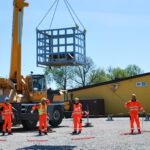
• Can the worker be struck by an object? for example, during crane operations
• Can the worker fall from one level to another?
• Can the worker be injured from lifting or pulling objects, or from carrying heavy objects?
• Do environmental hazards (dust, chemicals, radiation, welding rays, heat, or excessive noise) result from the performance of the job?
- Determine preventive measures
The last step involves drawing up a plan for controlling each hazard associated with each task.
Using the industry standard hierarchy of hazard controls is useful for this step. The hierarchy of hazard controls are, in order of effectiveness:
- Elimination and/or substitution: If you can remove the hazard entirely, or put some form of substitute in place, do that. That’s the best way to deal with a hazard–make it go away. An example would be removing a sharp edge on the corner of a machine so nobody could get cut.
- Engineering controls: Engineering controls involve re-designing the work area so that the hazard is eliminated or reduced. An example would be enclosing a noisy motor inside a sound-proof box.
- Administrative controls: Administrative controls involve modifying the way people work around a hazard to reduce the risk. An example might be limiting the number of hours someone works lifting heavy boxes from the end of a conveyor belt.
- Personal protective equipment (PPE): PPE can be used to protect people who are working in the presence of hazards. An example would be giving a respirator to someone working near airborne crystalline silica. PPE should only be used as a last resort, once the other forms of controls listed above have been tried. PPE may be used in combination with the other forms of controls.
Review of Job Hazard Analysis (JHA)
A job safety analysis can do much toward reducing accidents and injuries in the workplace, but it is only effective if it is reviewed and updated periodically. Even if no changes have been made in a job, hazards that were missed in an earlier analysis could be detected.
If an illness or injury occurs on a specific job, the job safety analysis should be reviewed immediately to determine whether changes are needed in the job procedure.
Any time a job hazard analysis is revised, training in the new job methods, procedures, or protective measures should be provided to all employees affected by the changes.
A job safety analysis also can be used to train effectively new employees on the steps and job hazards.
Interested in learning more? Contact us for our various health and safety trainings.
Contact us on +234 9115687051 or Email us at training@primeliftsafetyng.com.
Visit our website at www.primeliftsafetyng.com